
If you design optomechanical assemblies, cryogenic instruments, or precision structures for space, it needs to work the first time. You build the requirements list and then assume environmental conditions and get to work. You spend endless hours iterating on the design, quantifying trades between configurations and refining components. When it works on paper, you build a mockup and test it in the lab. Design reviews ensue and you refine the design, consolidate components and optimize geometries.
Finally, it’s time for production. You build the final version and test it. Everything works perfectly in the lab and it’s ready for launch, but there is an uncertainty baked in from the beginning…the environmental assumptions. Each component slightly changes shape with temperature shifts. You know this. You modeled it and tested it in the lab, but the true environment is hard to capture sometimes. Is the temperature uniform? How good were the models? Are the predicted thermal gradients accurate? Are the assumed temperature extremes correct?
Why traditional thermal expansion fixes only manage the problem
Thermal expansion can push optical benches out of alignment, change preload in bolted joints, and break thermal contact in cryo testing. Engineers have long-standing ways to fight it, and each one has its drawbacks.
Invar and CFRP minimize how much a material moves, but they only reduce expansion of one component, they do not compensate for the expansion of others, and they bring their own tradeoffs: moisture sensitivity, potential creep and shock, stability, and cost. Active control can correct for changes after they happen, which means added system complexity in power, sensors, and control hardware and software, all adding size, weight, and more failure modes. Adding compliant mechanisms can sometimes help, but adds weight, which is the last thing you want in a mass constrained system. In every case the expansion is still there. You are working around it, not eliminating it.
What is negative thermal expansion (NTE)?
Negative thermal expansion (NTE) is when a material shrinks as it is heated instead of expanding. ALLVAR Alloy 30 has a coefficient of thermal expansion (CTE) of -30 ppm/°C at room temperature, which is larger in magnitude than most other metals and alloys. This large magnitude means it can cancel the expansion of common materials like aluminum, titanium, or Invar.
That compensation is the whole idea. It inverts the way you think about the thermal expansion problem. Nearly every material an engineer reaches for grows when it heats and shrinks when it cools. ALLVAR alloys do the opposite. Pair a material that shrinks with one that grows, and the net movement of the assembly trends toward zero. This is thermal compensation done passively, with no power, no sensors, and no control loop. Fewer parts in a simple system means fewer interfaces, less mass, and greater reliability. A passive, elegant athermal solution.
Why we built a calculator for washers
Simply put, NTE is easy to describe, but hard to feel. A coefficient on a datasheet does not tell an engineer what it does to their design, whether it is a fastened joint, lens stack, telescope, or thermal switch. Many of the normal engineering rules of thumb must be reevaluated. Designing with a material that contracts when heated means developing new techniques around compensating the materials that expand. That is a genuinely different design paradigm, and paradigms do not shift because of a number in a table.
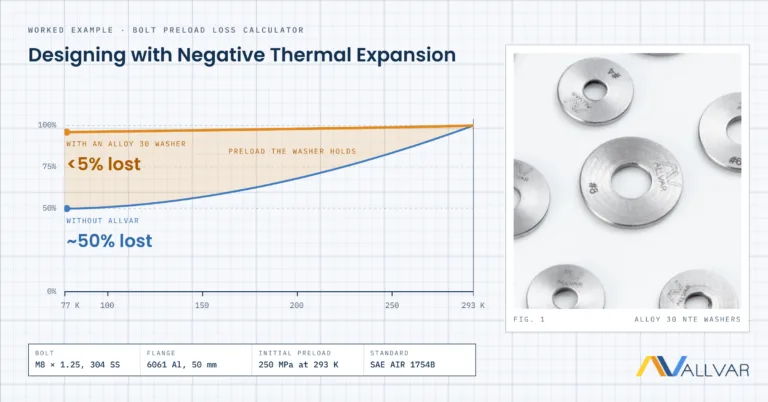
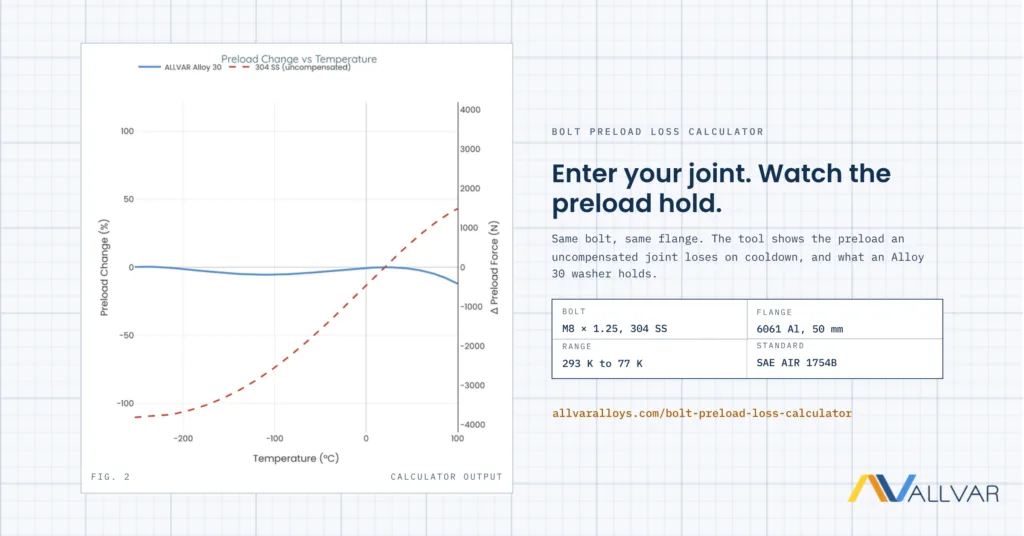
We built the Bolt Preload Loss Calculator to turn the behavior into something you can see. You enter the parameters of a bolted joint and a temperature range, and the tool shows standard preload loosening as the joint cools. The calculator then determines the right ALLVAR Alloy 30 washer thickness to keep the preload steady. You can even change the washer thickness with a slider and see how the preload shifts. Seeing the graphs move does in a few seconds what a spec sheet cannot. Once the behavior is visible and you have a feel for it, you can tune, play around, and create systems that exceed the current design paradigm.
Examples where NTE earns its place
We believe that you need the right tool for the right job and the right material for the right application. NTE is not the answer to every thermal problem. It is the elegant answer to specific problems, and it lets engineers push past conventional limits and achieve demanding performance requirements. Space-based telescopes, cryogenic instruments, high-performing thermal switches, and lunar payloads are applications that show what that looks like in practice.
Cryogenic labs and instrumentation
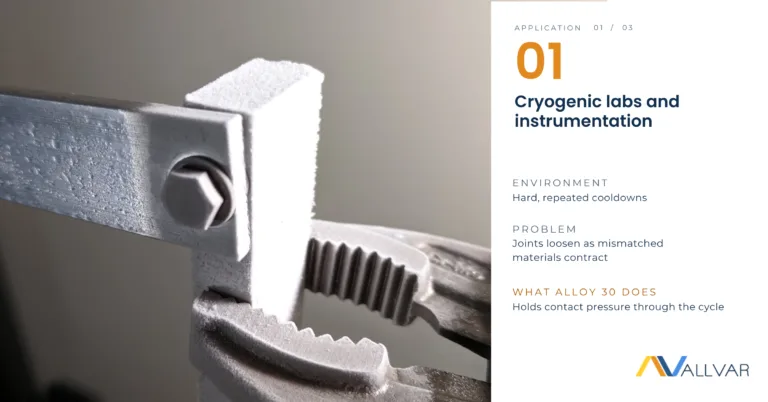
Cryogenic test rigs experience extreme cold and a joint that holds firmly at room temperature can loosen as its materials contract at different rates. Add repeated thermal cycles into the mix and joints that worked at the beginning can come loose over time. This loosening means lost thermal contact, drift, and repeatability problems that eat weeks of test time. Lost contact also means worse thermal across the joint. An ALLVAR Alloy 30 compensating washer holds contact pressure steady even through cycles, so the joint stays as tight as when you built it.
High-altitude balloon telescopes
A balloon-borne telescope operates in one of the most thermally hostile environments short of orbit, with large temperature swings between day and night cycles. Size and weight are also tightly constrained, and rework is impossible once the payload is aloft, which rules out the heavy active focus mechanisms that work on the ground. ALLVAR alloys can hold balloon-borne telescope structures stable against those temperature swings without drawing power or adding significant mass. That makes NTE a strong candidate for balloon payloads, where passive compensation may be the only kind that survives the flight.

The Nancy Grace Roman Space Telescope
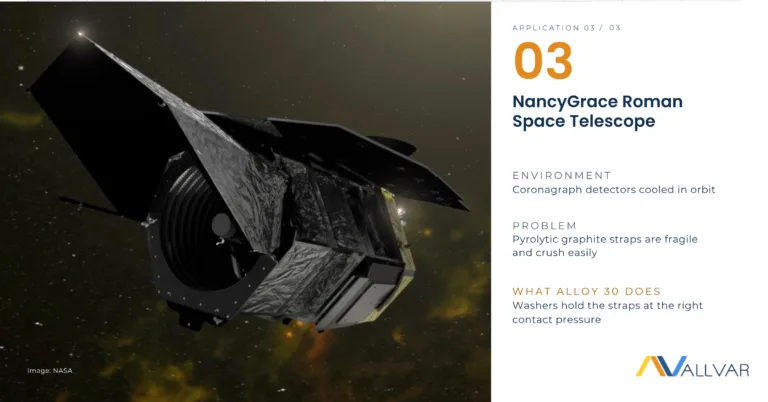
On the Nancy Grace Roman Space Telescope’s Coronagraph Instrument, ALLVAR Alloy 30 washers sit in the cryogenic sub-assembly and hold delicate pyrolytic graphite thermal straps at the right contact pressure. Pyrolytic graphite is close to an ideal thermal strap material, with high thermal conductivity and low density, but it is fragile and easy to crush. NTE washers grip it firmly without breaking it and maintain that gentle but firm grip across wide temperature swings so heat keeps moving out of the detectors during cryogenic cooling. The result was a solution to a difficult thermal problem that hit the size, mass, and thermal requirements. These novel ALLVAR Alloy 30 NTE washers help enable the use of pyrolytic graphite in a brand new configuration so the Coronagraph can demonstrate technology for directly imaging planets around other stars.
A simple solution to a hard problem
Return to that design process for a moment. Teams spend years creating cutting edge systems thinking about thermal stability the whole way. The pursuit underneath all of it is always the same: what is the best solution to this genuinely hard problem.
It is hard to imagine anything simpler or more elegant than a material that naturally does the compensation for you. Reliable. Tunable. Stable. No power, no moving parts, no electronics that let the magic smoke out. NTE will not solve every thermal problem in every system, but where it fits, it replaces complexity with a simple washer, strut, or spacer.
Try it out for yourself [Try the Bolt Preload Loss Calculator →] and watch preload hold across a temperature swing for a joint of your own. If it does what you need, [request a sample or a quote →].
NTE Frequently Asked Questions
Negative thermal expansion is when a material shrinks as it is heated rather than expanding. This shrinking is the opposite of most other materials that have a positive thermal expansion. ALLVAR Alloy 30 has a CTE near -30 ppm/°C at room temperature, which lets it cancel the expansion of positive CTE materials like aluminum, titanium, and Invar.
You pair an NTE material with a positive CTE one and adjust their relative proportions so their movements cancel. The result is an assembly whose net dimensional change can be selectively tuned. For more detail, see What is negative thermal expansion? and Matching ZERODUR’s CTE.
Applications that need dimensional or preload stability across large temperature swings and cannot rely on power or active systems, such as cryogenic instrumentation, space telescopes, high-altitude balloon payloads, thermal switches, and precision optical mounts.
No. It is one tool in a thermal design toolkit, not a universal fix. It is best suited to passive thermal stability in one direction where active control or added mass cannot be afforded.