
Athermalized Bolt Preload Calculator | Temperature Stable Preload
Home » Bolt Preload Loss Calculator
ALLVAR Alloy 30 washers and spacers are designed to keep joints at just the right preload, from extreme cryogenic temperatures to 100°C. The calculator below shows how ALLVAR Alloy 30 maintains preload across a wide temperature range compared to an uncompensated joint. See for yourself below! Instructions for the calculator are further down the page.
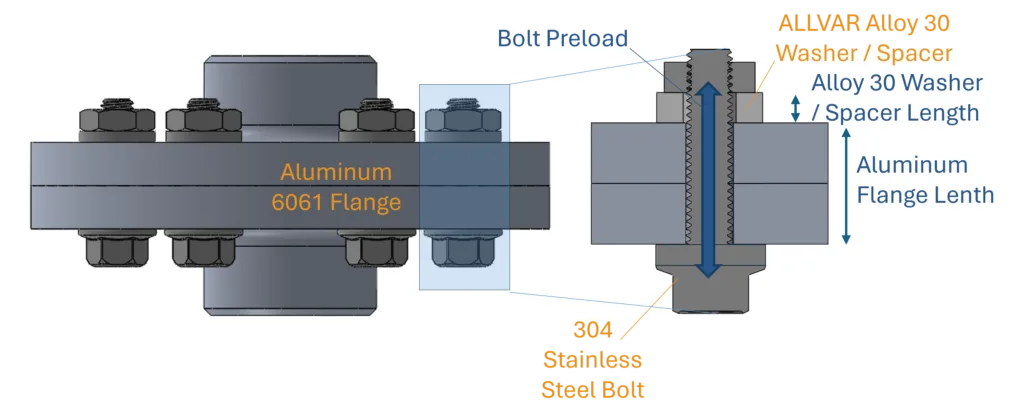
Here’s a diagram showing each portion of the calculator. An aluminum 60161 flange is shown bolted with 403 stainless steel bolts. The bolt preload is loaded to a specific MPa.
Washer Thermal Compensation Calculator
Never Lose Preload Again – Athermalized Bolt Calculator
In cryogenic bolted joints, differential contraction from mismatched Coefficients of Thermal Expansion (CTE) can cause significant preload variation. Standard torque-preloaded fasteners (e.g., 304 SS bolts clamping Aluminum 6061) lose substantial preload upon cooling — often exceeding safety margins — risking fatigue, loosening, joint separation, or overload during thermal cycling.
Without any type of thermal mismatch compensation, the bolted joint will undergo significant preload loss, particularly when cooling down to cryogenic temperatures. With ALLVAR Alloy 30 spacers, the bolted joint can maintian a stable preload across temperatures.
How to use the Preload calculator:
1) Choose your bolt size and aluminum flange length. This calculator assumes you are bolting 304 SS bolts to an aluminum 6061 flange. You pick the thickness of the overall flange.
2) Pick a bolt preload or stress.
3) Select a temperature range for your application. The full range will be shown by default. If you would like to calculate the thickness via SAE Air 1754B or Gradient Descent, a narrower temperature range will be used for the calculation.
4) Grab the slide to adjust the length of a ALLVAR Alloy 30 Washer. Even with wide tolerances, the preload change is relatively small.
5) Select to calculate the thickness with SAE AIR 1754B or a Gradient Descent.
Notes for the calculation:
The SAE Air Method calculates the thickness needed to minimize the preload difference between two specific temperatures. Here is a link to this specific standard. AIR1754B: Washer, Thermal Compensating, Metric Series – Information Report
The Gradient Descent Method determines a minimum preload across the entire temperature range between two temperatures, but tends to have larger preload “tails” at each end of a temperature range.
Order Constant preload Washers
Ready to significantly improve the preload of your bolted joint design? Order ALLVAR Alloy 30 washers or spacers today.
Disclaimer - Educational Tool Only
This thermal preload calculator is provided as an educational resource only. It is not intended, and should not be used, as a substitute for professional engineering analysis, detailed finite element modeling, or validated design calculations performed by a qualified engineer.
The results generated by this tool are approximations based on simplified assumptions and generalized formulas. They may not account for all real-world variables, material variations, tolerances, environmental conditions, joint geometry, or specific application requirements.
ALLVAR makes no representations or warranties, express or implied, regarding the accuracy, completeness, reliability, or suitability of this calculator or its results for any particular purpose. Use of this tool is at your own risk.
We expressly disclaim all liability for any damages, losses, injuries, design failures, product failures, property damage, personal injury, economic loss, or any other consequences (whether direct, indirect, incidental, consequential, special, or punitive) arising from or related to the use of, reliance on, or inability to use this calculator, even if we have been advised of the possibility of such damages.
Always verify critical calculations through independent engineering analysis and testing before relying on them for design, manufacturing, or safety-related decisions.